

Cart
0
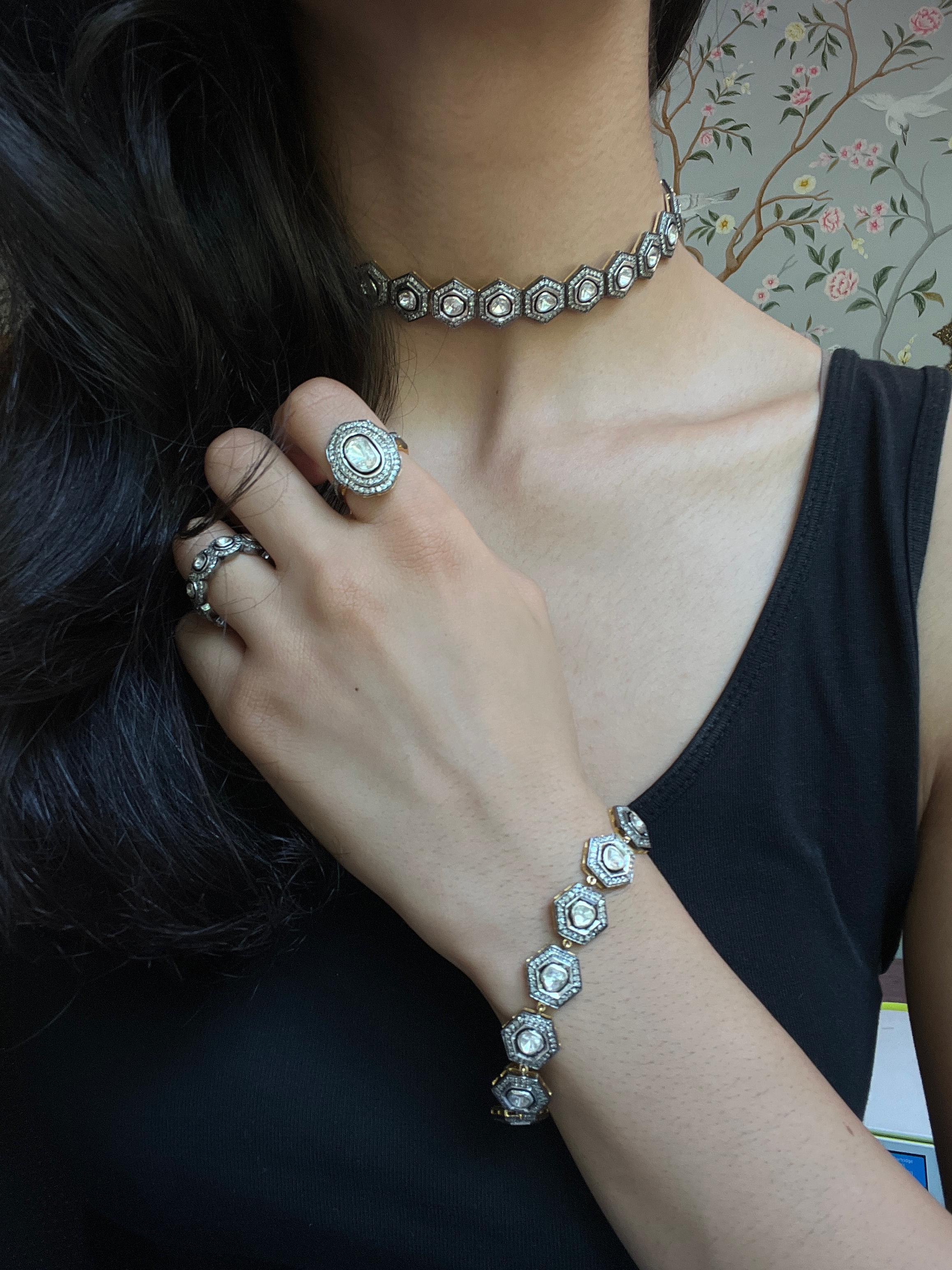
Walk through the jewellery lanes of Jaipur’s Johari Bazaar and three words will follow you from shop to shop: Polki, Kundan, and Meenakari. They are used interchangeably by casual shoppers, conflated in product descriptions on e-commerce sites, and frequently misunderstood even by jewellery enthusiasts who have been wearing them for decades.
Yet these three terms describe entirely different things. One refers to a material. Another to a setting technique. The third to a decorative art form. Understanding the distinction is not merely academic — it changes how you buy, how you style, and how you care for your jewellery.
At Firuzeh Jaipur, all three traditions come together in a single piece of handcrafted jewellery. Our Polki Collection, for instance, uses uncut diamonds (Polki) set using the Kundan technique, with exquisite Meenakari enamel work on the reverse. Understanding each tradition helps you appreciate why a single Firuzeh earring can take weeks to craft — and why it is worth every day of waiting.
What Is Polki Jewellery?
The Material: Uncut, Unfaceted Diamonds
Polki refers specifically to uncut, natural diamonds that are used in their raw, unfaceted form. Unlike the brilliant-cut diamonds you see in modern solitaire rings — where the stone is machine-cut into dozens of precise facets to maximise sparkle — Polki diamonds retain their original surface and organic shape. They are flattened, set into gold foil, and backed with silver to reflect light through the stone.
The result is a glow that is distinctly different from cut diamonds: softer, warmer, more diffused. It is often described as “moonlight on water” — luminous without being sharp. This warmth is precisely what gives Polki jewellery its romantic, vintage character.
History
Polki jewellery has been part of Indian royal adornment for over 2,500 years, with its most celebrated period during the Mughal era (16th–19th century). The Mughal courts of Delhi, Agra, and Lucknow commissioned Polki pieces of extraordinary scale and complexity. When the Rajput kings of Rajasthan adopted Mughal court traditions through alliance and intermarriage, Polki craft found a permanent home in Jaipur, where it thrives to this day.
How Firuzeh Uses Polki
Firuzeh’s Polki Collection celebrates the raw, unrefined beauty of uncut diamonds. Each piece combines Polki diamonds with vibrant gemstones — tourmalines, tanzanites, emeralds, and rubies — set in 14k to 22k gold. The collection is handcrafted using age-old Jaipuri techniques, reimagining the grandeur of the Mughal era for the contemporary world.
What Is Kundan Jewellery?
The Technique: Setting Stones in Gold Foil
Kundan is not a material — it is a technique. Specifically, it refers to the method of setting gemstones (or glass) into a gold framework using lac (a natural resin) and thin strips of refined gold foil (kundan). The artisan first creates a skeletal gold framework, fills the cavities with lac to create a bed, places the stone on top, and then presses thin gold strips around the edges of the stone to hold it in place.
No claws, no prongs, no machine setting — just gold foil pressed by human hands with extraordinary precision. This is one of the oldest forms of gemstone setting in the world and remains entirely manual to this day.
The Key Distinction
Here is where the confusion usually lies: Polki jewellery is almost always set using the Kundan technique. So when you hear “Polki Kundan jewellery,” it means uncut diamonds (Polki) set using the gold-foil pressing method (Kundan). However, Kundan setting can also be used with cut gemstones, glass stones, or coloured gems — not just Polki diamonds. So “Kundan jewellery” is a broader category than “Polki jewellery.”
Think of it this way: all Polki jewellery uses Kundan setting, but not all Kundan jewellery contains Polki diamonds.
History
The Kundan technique originated in the royal courts of Rajasthan and Gujarat, with Jaipur and Bikaner emerging as the primary centres of excellence. The city of Jaipur, in particular, became synonymous with Kundan work after Maharaja Sawai Jai Singh II invited master artisans from Lahore and Delhi to establish workshops in the newly built Pink City in the early 18th century. Those artisan lineages continue today, and many of the craftsmen working in Jaipur’s ateliers can trace their family’s involvement in Kundan work back six or seven generations.
How Firuzeh Uses Kundan
Every piece in Firuzeh’s Fine Jewellery and Polki Collection is set using the Kundan technique. The Pearl Kundan Necklace Set, for example, combines freshwater pearls with Kundan-set stones in a gold-plated silver alloy framework — making the Kundan tradition accessible at a wider range of price points while maintaining artisanal integrity.
What Is Meenakari Jewellery?
The Art: Enamel Work on Metal
Meenakari (also spelled Minakari) is the art of applying coloured enamel to metal surfaces — typically gold, silver, or copper. The word comes from “mina,” the Persian word for enamel. The artisan engraves fine grooves into the metal surface, fills them with powdered glass in specific colours (red, green, blue, white, and pink are traditional), and then fires the piece in a kiln at high temperatures. The glass melts, fuses with the metal, and solidifies into a smooth, vivid, permanent coating.
Meenakari is not a standalone jewellery type in the way Polki is. It is a decorative technique — an embellishment applied to jewellery that may also feature Kundan setting and Polki diamonds. In the finest traditional pieces, you will find all three: Polki diamonds on the front, set using Kundan technique, with Meenakari enamel work on the reverse.
History
Meenakari is believed to have originated in Persia and was brought to India by Mughal artisans during the reign of Emperor Akbar in the 16th century. The craft took root in Rajasthan, where it merged with existing Kundan and Polki traditions to create a uniquely Indian art form. Jaipur became the undisputed capital of Meenakari work, a position it holds to this day. The city’s Meenakars (enamel artists) are specialists — often a single family will dedicate itself entirely to one colour, spending a lifetime mastering the precise temperatures, glass mixtures, and firing techniques required for that specific hue.
The Hidden Beauty
One of the most distinctive features of high-quality Meenakari is that it is often on the reverse of the jewellery. A Polki necklace from Jaipur will dazzle with diamonds and gold on the front, but turn it over and you will find a garden of enamel flowers, leaves, and geometric patterns in vivid reds, greens, and blues. This “hidden beauty” is a hallmark of Jaipuri craft — the idea that even the unseen side of a piece should be beautiful, because true craftsmanship is never only skin-deep.
How Firuzeh Uses Meenakari
Firuzeh’s handcrafted pieces frequently feature Meenakari on the reverse of Kundan-set jewellery, continuing Jaipur’s long tradition of double-sided artistry. The enamel work adds not just beauty but also structural integrity, as the lac and enamel layers protect the gold framework and stone settings from behind.
Polki vs Kundan vs Meenakari: Side-by-Side Comparison
|
Aspect |
Polki |
Kundan |
Meenakari |
|
What it is |
A material – uncut, unfaceted natural diamonds |
A technique – setting stones in gold foil using lac |
A decorative art – applying coloured enamel to metal |
|
Origin |
Mughal courts, 2,500+ years old |
Rajasthani & Gujarati royal courts, 18th century Jaipur peak |
Persian origin, brought to India by Mughal artisans (16th century) |
|
Primary centre |
Jaipur, Rajasthan |
Jaipur & Bikaner, Rajasthan |
Jaipur, Rajasthan |
|
Key characteristic |
Warm, diffused glow of uncut diamonds |
Gold-foil pressed setting, no prongs or claws |
Vivid coloured enamel fired onto metal at high temperature |
|
Placement |
Front of jewellery (visible stone) |
Framework holding the stones |
Often on the reverse (hidden beauty tradition) |
|
Materials used |
Natural uncut diamonds, gold, silver foil backing |
Gold foil strips, lac (resin), gemstones or glass |
Powdered glass (enamel), gold/silver base, kiln firing |
|
Price range |
High – uses real diamonds and high-karat gold |
Variable – depends on whether stones are real or glass |
Adds 15–25% to the cost of a piece due to labour intensity |
|
Can they coexist? |
Yes – Polki is always set using Kundan; often has Meenakari on reverse |
Yes – Kundan is the setting for both Polki and other stones |
Yes – Meenakari decorates the reverse of Kundan & Polki pieces |
|
Occasions |
Weddings, receptions, milestone celebrations, investment |
Weddings, festive occasions, everyday (if using glass/silver) |
All occasions – it embellishes any Kundan or Polki piece |
How All Three Come Together in a Single Piece
The finest traditional Indian jewellery — and the kind Firuzeh specialises in — is not Polki or Kundan or Meenakari. It is all three simultaneously.
Here is how a single Firuzeh earring is constructed:
• Step 1: The goldsmith creates a skeletal gold framework (the “ghat”) in the desired shape — a chandbali crescent, a jhumka dome, or a stud disk.
• Step 2: Lac (natural resin) is heated and pressed into the cavities of the framework to create a stable bed for the stones.
• Step 3: The Kundan artisan places Polki diamonds and coloured gemstones (emeralds, rubies, tourmalines) onto the lac bed and presses thin strips of refined gold foil around each stone to lock it in place. This is the Kundan technique.
• Step 4: The piece is turned over to the Meenakar (enamel artist), who engraves fine grooves into the reverse of the gold surface, fills them with coloured glass powder, and fires the piece in a kiln. This Meenakari work creates the vivid floral or geometric patterns on the back.
• Step 5: Finishing — the piece is polished, pearls or beads are strung where needed, and clasps or hooks are attached.
This process involves at least four different specialist artisans (goldsmith, lac worker, Kundan setter, and Meenakar), each of whom has trained for years in their specific craft. A single complex piece can take 3–6 weeks to complete.
Buying Guide: Which Tradition Suits You?
Choose Polki If
• You want jewellery with real diamonds and high intrinsic value
• You are buying for a wedding, engagement, or milestone occasion
• You appreciate the warm, vintage glow of uncut stones over sharp modern sparkle
• You are building an heirloom collection that appreciates over time
• Browse: Firuzeh’s Polki Collection
Choose Kundan If
• You love the gold-foil setting aesthetic but want more flexibility on price
• You want colourful gemstone or glass-stone jewellery in a traditional framework
• You are buying for festive occasions, gifting, or building a versatile wardrobe
• Browse: Firuzeh’s Fine Jewellery and Silver Sample Sale for Kundan pieces in silver alloy at accessible price points
Choose Meenakari If
• You love colour and the idea of “hidden beauty” on the reverse of your jewellery
• You want a piece that reflects the highest level of Jaipuri artisanship
• You are buying a statement piece where both sides of the jewellery matter to you
• Tip: Look for Meenakari detailing in Firuzeh’s Polki and Fine Jewellery collections — it often appears on the reverse of earrings, pendants, and tikkas
Care Tips for Each Tradition
Polki Jewellery
• Store in individual soft pouches to avoid surface scratching on the uncut diamond faces
• Keep away from water, perfume, and chemicals — the lac backing can soften with moisture
• Clean with a soft, dry cloth only; never use ultrasonic cleaners or steam
• Professional re-polish every 2–3 years to maintain the gold’s lustre
Kundan-Set Jewellery
• Avoid pressure on individual stones — the gold-foil setting can loosen if subjected to force
• Never submerge in water; lac dissolves with prolonged moisture exposure
• Store flat in a padded box to prevent the weight of the piece from pressing on stone settings
• Have a jeweller check and re-press any loose gold foil strips annually
Meenakari Jewellery
• Avoid impact — enamel can chip or crack if dropped on a hard surface
• Keep away from acidic substances (lemon juice, vinegar, certain cleaning products) that can dull enamel
• Clean with a soft damp cloth; dry immediately. Never soak.
• Store separately — the textured enamel surface can scratch other pieces if stored together
Three Traditions, One Story
Polki, Kundan, and Meenakari are not competing styles — they are collaborating arts. The diamond needs the setting. The setting needs the embellishment. Together, they create something greater than any single technique could achieve alone.
This is what Firuzeh means when it speaks of “finely crafted jewels that evoke a sense of nostalgia.” Every piece is a meeting point of three ancient traditions, handcrafted in Jaipur by artisans whose families have practised these arts for generations. When you wear a Firuzeh earring, you are not wearing Polki or Kundan or Meenakari — you are wearing all three, compressed into a single object of extraordinary beauty.
Explore the Polki Collection, Fine Jewellery, Pearl Collection, and all of Firuzeh’s collections.


