Cart
0
Diamonds tend to dominate the jewellery conversation, but some of the most striking pieces in fine jewellery rely on colour instead of sparkle. Tourmaline, tanzanite, and emerald are three of the most sought-after coloured gemstones, each with its own character and reason for turning up again and again in fine jewellery collections.
Tourmaline: The Gemstone With Endless Colour Range
Tourmaline is unusual among gemstones because it occurs in nearly every colour imaginable, from pink and green to blue, yellow, and even bi-colour stones with two shades in a single crystal. That range makes it one of the most versatile choices a jewellery designer can reach for; no other single gemstone family offers this much colour flexibility. Pink and green tourmaline have become especially popular in contemporary fine jewellery, often paired with diamonds or other coloured stones for depth. Because it comes in so many shades, tourmaline also pairs unusually well with almost any metal tone, from yellow gold to rhodium-plated silver. Look for even, saturated colour without visible inclusions that affect clarity; bi-colour tourmaline, where two distinct shades appear in one stone, is especially prized for its rarity.
Tanzanite: The Rare Blue-Violet Stone
Tanzanite is found in exactly one place on earth, the Merelani Hills near Mount Kilimanjaro in Tanzania, which makes it significantly rarer than most gemstones used in fine jewellery. It's a relatively recent discovery, first identified in the late 1960s, but it earned its place quickly thanks to a striking blue-violet colour unlike anything else. Its colour can actually shift depending on the angle it's viewed from, a property called pleochroism, sometimes reading more blue, sometimes more violet, depending on the light. That gives tanzanite jewellery a subtlety that's hard to replicate with more uniformly coloured stones. When choosing tanzanite, look for a rich, saturated blue-violet rather than pale or greyish tones, and keep in mind that it's softer than stones like sapphire or ruby, so pieces should be set securely and worn with a bit more care.
Emerald: The Enduring Green Standard
Emerald has been prized in fine jewellery for thousands of years, valued for a shade of green so distinctive it has its own name. It's historically associated with royalty and has long been paired with diamonds and pearls in traditional Indian jewellery, and it remains one of the most recognisable coloured gemstones anywhere. Unlike diamonds, emeralds are prized even with visible inclusions, sometimes called jardin (French for garden) because of how they resemble small, natural, plant-like patterns inside the stone. A completely flawless emerald is rare enough that inclusions are generally accepted as part of its character rather than a flaw. When shopping, look for deep, even green colour with good transparency, and know that emeralds are often treated with oils or resins to improve durability and clarity, a common, accepted industry practice worth asking your jeweller about. Browse our emerald rings.
More Stones We Work With
Aquamarine has the clarity and coolness of shallow tropical water, which makes it a natural partner for Art Deco designs; our Aquamarine Ruby Diamond Halo Ring shows how well it contrasts with warm stones. Opal is known for its play of colour, and no two are identical; the Opal Emerald Pendant Mala pairs it with emerald. Ruby, the stone of passion, anchors pieces such as the Rubina Ring (see all ruby rings). Jade is rare in Indian fine jewellery, and our Jade & Polki Diamond Pendant Necklace sets it in polki, bridging two very different gem traditions.
How to Choose Coloured Gemstone Jewellery
A few principles apply across all three stones, and coloured gemstones more broadly. Colour matters more than size: a smaller stone with rich, even colour will usually look better and hold more value than a larger stone with dull or uneven colour. The setting affects how the colour reads, since gold tends to warm up a stone's tone while silver or white metal makes cooler colours like blue and violet look more vivid. And pairing matters, since many fine jewellery pieces combine coloured gemstones with diamonds or pearls specifically to let the colour stand out against a neutral backdrop.
Choosing a Gemstone by Birth Month
If you're buying for a birthday, the traditional birthstones are: January garnet, February amethyst, March aquamarine, April diamond, May emerald, June pearl, July ruby, August peridot, September sapphire, October opal or tourmaline, November citrine, and December tanzanite.
Gemstone Care
Softer stones such as opal, pearl, and turquoise need the most care, so keep them away from water and chemicals. Harder stones such as emerald, sapphire, and ruby are more durable, but should still be stored separately to avoid scratching other pieces. All gemstones benefit from periodic professional cleaning.
Whether you're drawn to the endless range of tourmaline, the rarity of tanzanite, or the timeless status of emerald, coloured gemstones offer something diamonds alone can't: real, individual character.
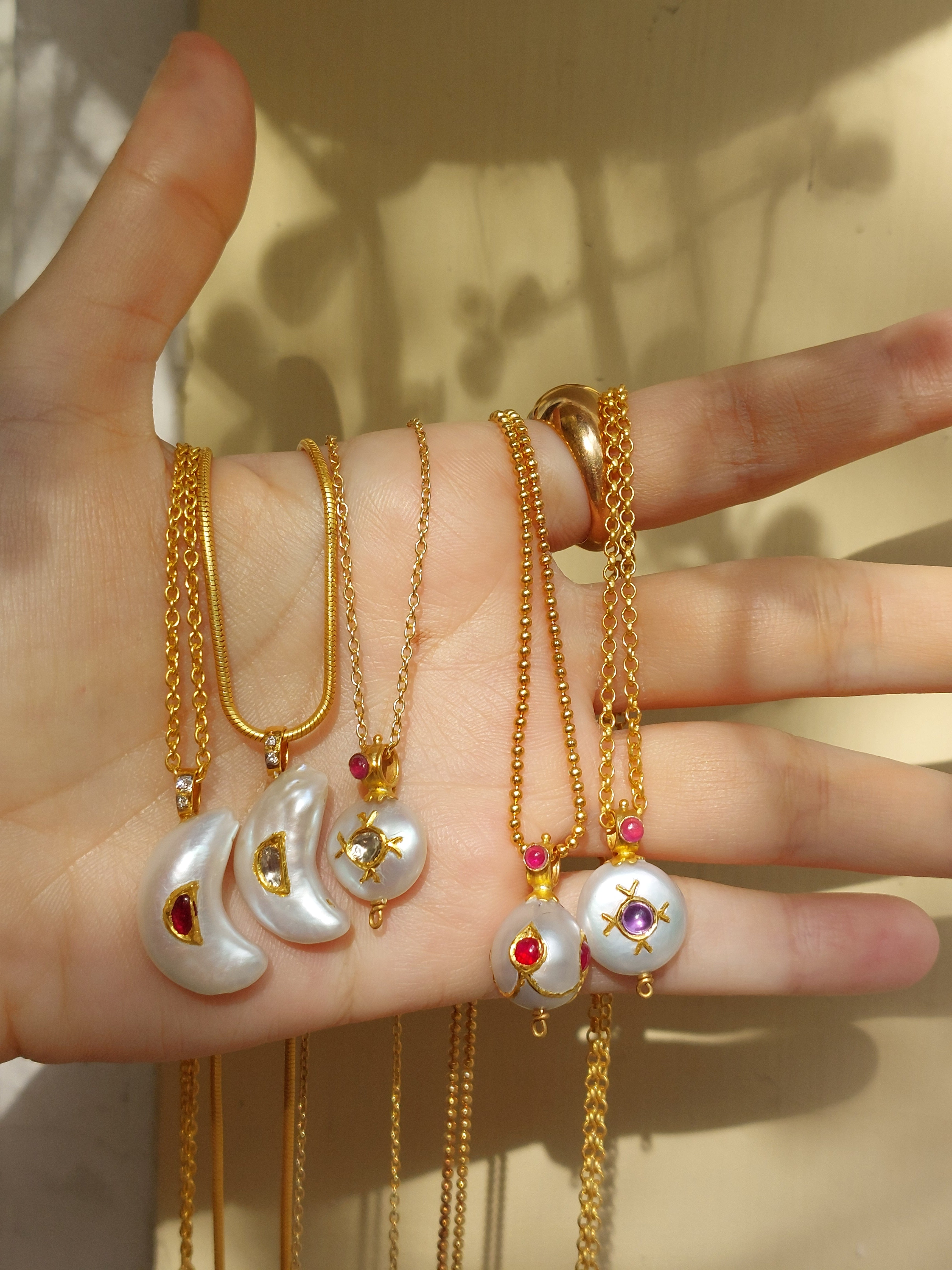
Explore Firuzeh's fine jewellery collection or our gemstone malas, tourmaline, tanzanite, emerald, and more, handcrafted into rings, earrings, and pendants at our Jaipur atelier.